


Hi there, I’m Robert. I share lessons and tools about the science of behavior change, with people working in transformation, culture change, leadership and products. For more: My company: aimforbehavior | Courses and Training | Tools
This is a series for people working on change and transformation in organizations. It’s a collection of the lessons, tools, and plays I’ve learned over 10+ years working in the messy reality of change, especially the last few years, where my work has focused on bringing behavioral science into transformation.
We’ll cover culture, engagement, operating systems, behavior change, adoption, and the patterns that make change hard to implement.
The first part of this series will covers three conditions that determine whether change becomes self-maintaining: Meaning, Mastery, and Belonging.
We’re starting with Meaning because when Meaning does not get supported, almost everything that happens next, training, comms, incentives, and measurements, ends up getting interpreted as pressure.
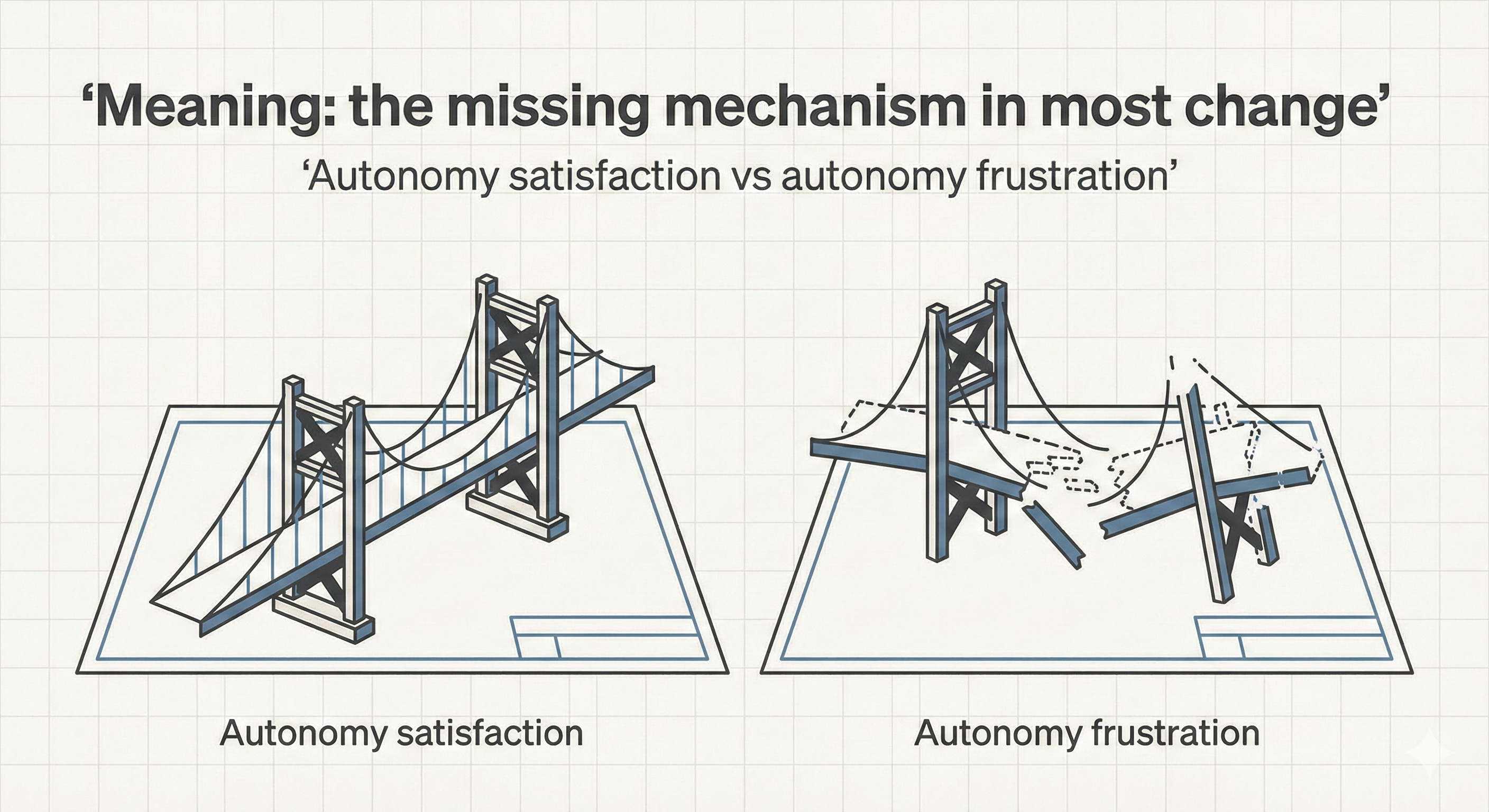
To clarify, Meaning is the sense-making mechanism that makes a change feel legitimate and self-endorsed in someone’s real context. In Self Determination Theory terms, it strengthens under autonomy satisfaction and collapses under autonomy frustration, which is why the same change can produce internalization in one system and reactance in another.
Comms isn’t the enemy here… it’s necessary but insufficient. If Meaning is weak, comms becomes the messenger for pressure.
Lets start with a short example:
Let’s say two equally resourced change programs launch inside two similarly capable organizations. One leads to steady adoption… people in the org ask practical questions, adjust workflows, and the new behaviors become normal. The other leads to half-compliance, workarounds, and slowly fades the moment leadership attention moves to the next thing.
While there are many things needed for change to happen, one of the things that is very important in change is Meaning… and specifically, whether the environment makes the change in the organization feel legitimate or whether it feels like something being imposed.
That distinction matters because while pressure or persuasion can absolutely produce behavior change in the short term, it produces the kind of change that does not last. Meaning is the mechanism that moves people from externally controlled action (“this is being done to us”) to internalized action (“this is something we are doing, for reasons we endorse”).
Your Meaning Tools (copy/paste)
If you want to use this as an actual playbook (not just an article), here are the things to take from it:
Meaning-killer audit (the subtraction move): the fastest way to stop autonomy frustration and prevent reactance.
Role-level rationale worksheet: the template that forces you past abstraction and into daily friction.
25-minute sense-making loop: a meeting structure that creates shared interpretation without turning into debate.
45-minute Meaning session: a one-team working session that produces outputs you can act on.
Language swaps: scripts for firm direction without coercion.
You’ll find each tool in the sections below.
What I mean by Meaning
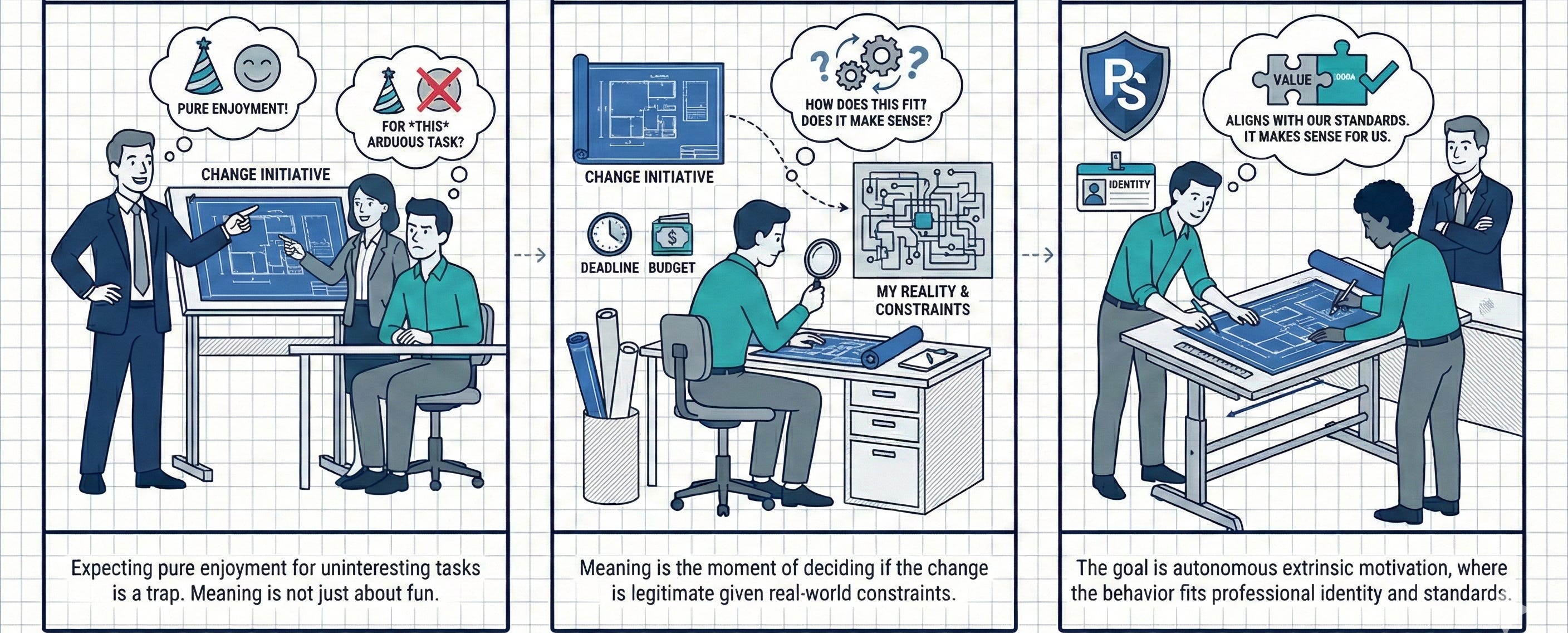
Meaning is sense-making under constraints. It’s the moment someone decides, in their own context, whether this change makes sense for their reality.... A key distinction here is to avoid the Intrinsic Trap. In organizations, we rarely expect employees to have intrinsic motivation (acting out of pure enjoyment) for uninteresting or arduous tasks.
One nuance: don’t only chase intrinsic motivation at work. For most change behaviors, the goal is autonomous extrinsic motivation… ideally integrated regulation, where the behavior fits professional standards and identity.
Quick caveat on the system
This isn’t a recipe, and it’s not linear. Organizational systems are adaptive: they absorb interventions, route around initiatives, and normalize workarounds that make initiatives look successful right up until you check what’s actually happening. So treat what follows as architecture + experiments, try one play in one workflow, see what the response is, and adjust, because Meaning isn’t something you “achieve,” it’s something you keep from disappearing.
Diagnosing Meaning Quickly
If you’re unsure whether Meaning is missing, or is very low, don’t start with a survey. Instead, start with some sense-making so you can understand what people can say, what they can’t say, and what the system is pushing as its default.
Six questions you can ask
1) Can people explain the change in one sentence?
2) Do they believe the rationale applies to their work, or only “the business”?
3) Can they name the specific friction removed for their role?
4) Do they have any agency (within constraints)?
5) Trade-off literacy: can they name what gets harder short-term without spiraling?
6) Voluntary uptake: does any adoption occur without incentives*, surveillance, or escalation? Contingent incentives can buy short-term action but often reduce internalization when they become the main adoption strategy.
*Research shows that contingent incentives can buy short-term action but often reduce internalization when they become the main adoption strategy.
Sense-making equilibrium (informal narrative / rumor load)
When the formal architecture of Meaning is weak, the system defaults to informal narrative as its primary sense-making mechanism.
If people are asking the questions below, it makes Meaning unstable:
“Why is this happening to us?”
“Who decided this?”
“What are they not telling us?”
However, If questions are more around operational integration
“How do we make this work with our current tools?”
“What do we stop doing to make space?”
“Who owns what?”
Then Meaning is starting to form.
Tool: Meaning-killer audit (How you subtract)
Ask two questions for each item below: (1) Are we doing this? (2) Where is it showing up (exact meeting / message / policy / metric)?
High-risk Meaning-killers:
· Pressure denial: pretending the change doesn’t add workload or cognitive load.
· Consultation theatre: asking for input when key decisions are already fixed.
· Surveillance-heavy rollout: monitoring and escalation as the primary adoption strategy.
· Controlling language: “must / have to / no excuses” framing.
· Fake agency: options that aren’t real, or choices that get overridden.
· Public status threats: shaming, ranking, calling out non-adopters.
If you want a rule of thumb: the moment people start optimizing for self-protection, Meaning is already unstable.
The Meaning playbook
Most change programs try to build Meaning by adding more; more comms, more decks, more town halls…when Meaning is actually a dual job: what happens when leaders support agency, and what happens when they frustrates it?
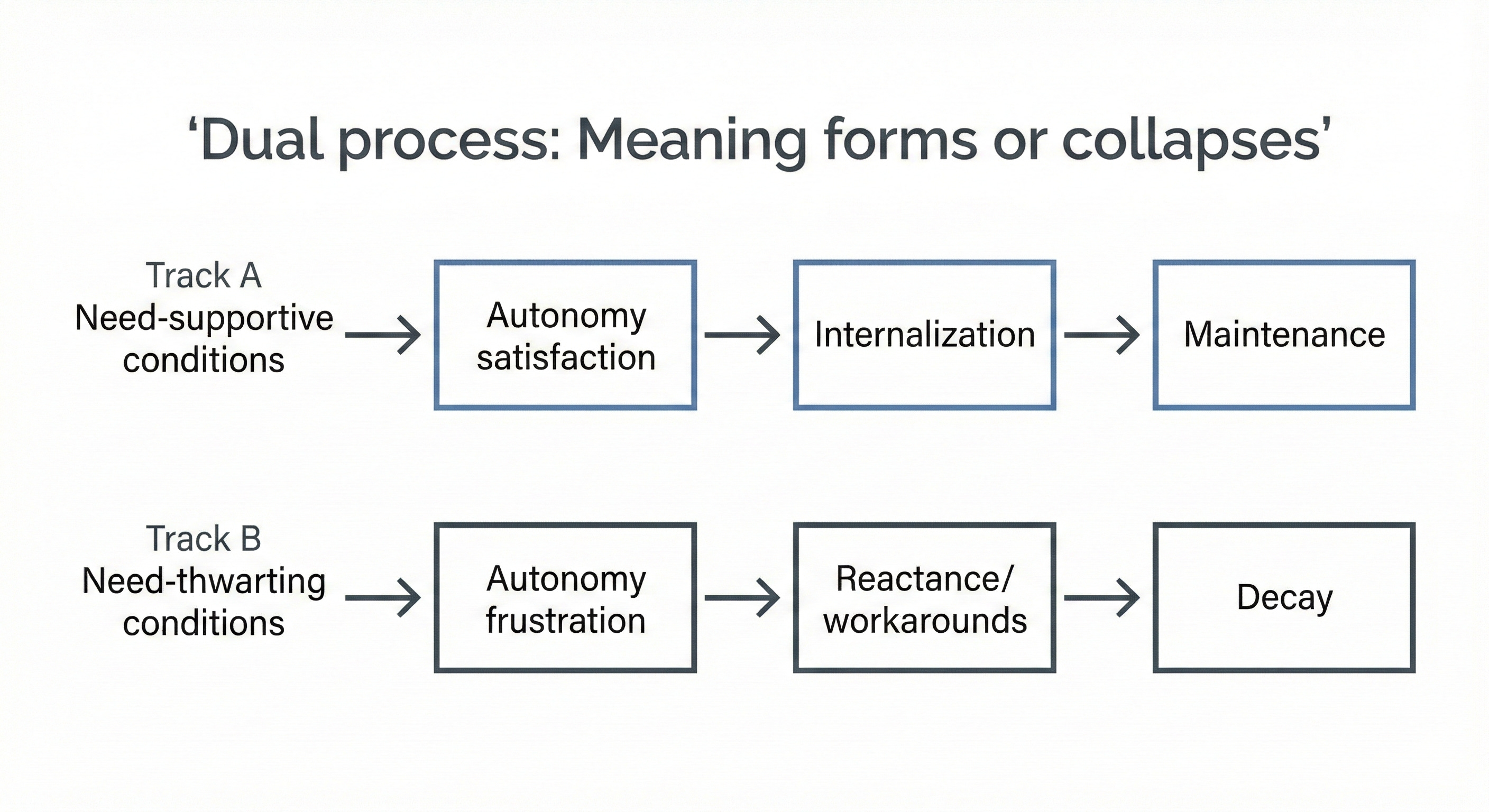
This is the “dual process” point that gets missed: motivation is shaped by need-satisfaction conditions and need-frustration conditions in parallel. If you add satisfaction conditions but keep the frustration conditions, you’ll still get some progress, but it will be driven by pressure, and pressure tends to trigger psychological reactance.
Reactance doesn’t always show up as a big bang. In organizations it’s usually more subtle: delaying things, less compliance, gaming the metrics, and workarounds that preserve peoples autonomy while keeping up appearances in the short term for leadership sake.
Below are 7 plays you can use right away, remember, they are not steps. They are plays you need to contextualize, test, iterate, and when validated scale.
Play: Strengthen the Rationale
A lot of rationales sound more like preferences:
“We want to be more agile”
“We want to standardize”
“We want to be customer-centric”
That’s not a rationale, it’s an aspiration. Meaning becomes credible when the rationale is evidence-informed and built from multiple sources rather than purely external sources like executive intuition. When a rationale feels made up in a boardroom, it creates an external locus of causality; for internalization to occur, the rationale must show the change is demanded by reality, making the behavior feel personally meaningful rather than coerced.
Use these three areas:
1) External constraints: market shifts, regulations, customer outcomes.
2) Internal signals: quality data, rework, incidents, attrition, delays.
3) Frontline reality: specific handoffs, tool pain, time pressure.
You’re not trying to overwhelm people with data. You’re trying to show legitimacy: this was demanded by reality, not invented in a boardroom.
Play: Write the rationale at three levels (company, team, role)
Most rationales are written at the wrong level. Write three versions of the why.
Company-level (external reality / direction)
Team-level (coordination / quality / throughput)
Role-level (what gets easier, what risk reduces, what friction goes away)
One refinement that works in practice: make the team-level rationale explicitly relational. In interdependent work, Meaning increases when the rationale makes coordination benefits concrete (i.e., how we stop letting each other down at handoffs, how we reduce rework that hits other teams, how we make dependencies visible). Role-level is where Meaning takes shape, because it’s where daily tasks can become easier.
Tool: the role-level rationale worksheet (copy/paste)
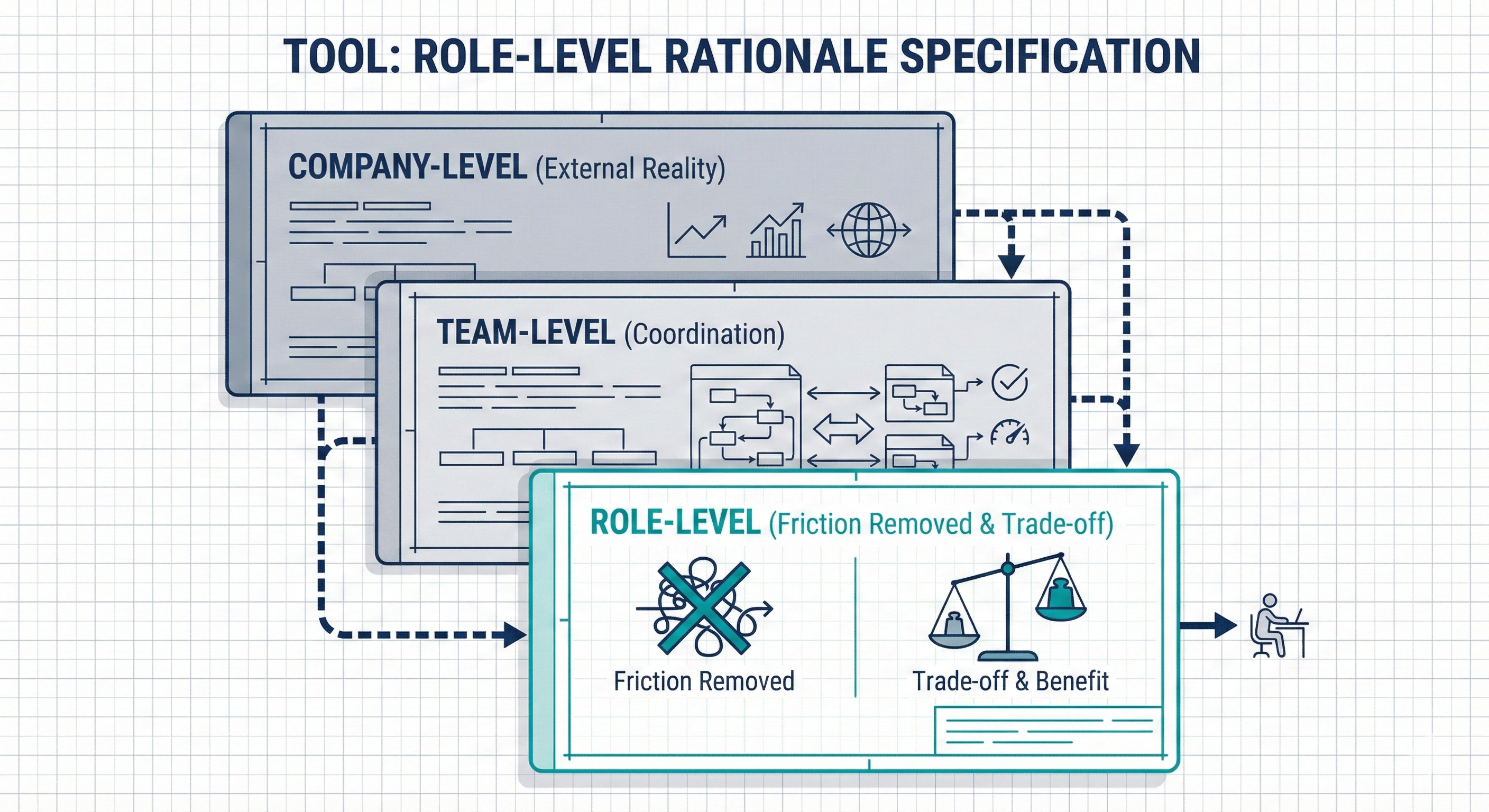
Write one version per key role. If you can’t fill the role line, you’re not ready.
· Company-level: This exists because ___ (external reality).
· Team-level: This helps because ___ (coordination/quality/throughput).
· Role-level: For your role, this removes ___ (daily friction/risk).
· Trade-off: What gets harder short-term is ___ (opportunity cost).
· Support: What we’ll change in the system to make it doable is ___ (time/tools/permissions/workflow).
One worked example (generic, but realistic)
Change: new CRM workflow.
Role-level (sales): “Fewer Friday data chases because updates are captured once, in the moment, and pipeline reviews stop being archaeology.”
Trade-off: “For the first 2–3 weeks, calls will feel slower while you learn the flow.”
Support: “We’re killing duplicate spreadsheets, simplifying required fields, and protecting 30 mins/day for practice in week 1.”
Note: if the system is already at 110% capacity, your rationale will sound like a threat unless you name what you’re taking off their plate.
Play: Make trade-offs open
Sometimes leaders hide the tradeoff costs because they think it protects motivation, however It usually does the opposite because people can feel the cost anyway, and if you don’t name it, they can assume it’s manipulation. So name it for what it is…
What gets harder short-term is…………” and then make the support equally concrete.
This isn’t about being negative… It’s actually helping to prevent reactance.
Play: Replace broadcasting with sense-making loops
Broadcast creates awareness, we know that, but dialogue creates Meaning. The goal in change may not be consensus, instead it’s shared interpretation, and it’s addressing those hard truths now that will help your initiative succeed.
This is a prompt that could work: “On one hand, you can see the reasons for change; on the other, you can see the pitfalls…. talk me through both.”
One additional play that makes this sharper (and reduces performative agreement) is to explicitly surface sources of pressure… where you can separate constraints from choices.
Quick check: if people can’t speak honestly in front of their manager, then “dialogue” is still just a broadcast.
Tool: a simple 25-minute sense-making loop (try it in a team meeting)
· 5 min: State the change in one sentence.
· 10 min: “On one hand / on the other hand” (find pros and cons).
· 10 min: Name the sources of pressure and risks (deadlines, oversight, workload, status risk) and agree what is negotiable vs not.
Keep it small… it’s all about shared interpretation, not agreement.
Play: Active participation
Treat participation as a design requirement, where you are giving people a real role in shaping the what/how in the change.
Examples of what “participation” can look like without taking away control:
Co-design the workflow at the point of work (what happens first/next, who owns what)
Decide the local rollout sequence (which teams go first, what gets paused)
Choose the minimum viable standard vs local flexibility
Define the handoff rules and escalation paths
Participation is not about making everyone happy…it’s about increasing agency and reducing the need to route autonomy through workarounds.
Play: Sharpen the Language
Meaning isn’t about being soft… it’s about providing clear direction without coercion.
One way to do this is with the language you use, because if the language sounds like a threat, people are going to optimize for safety.
Tool: language swaps
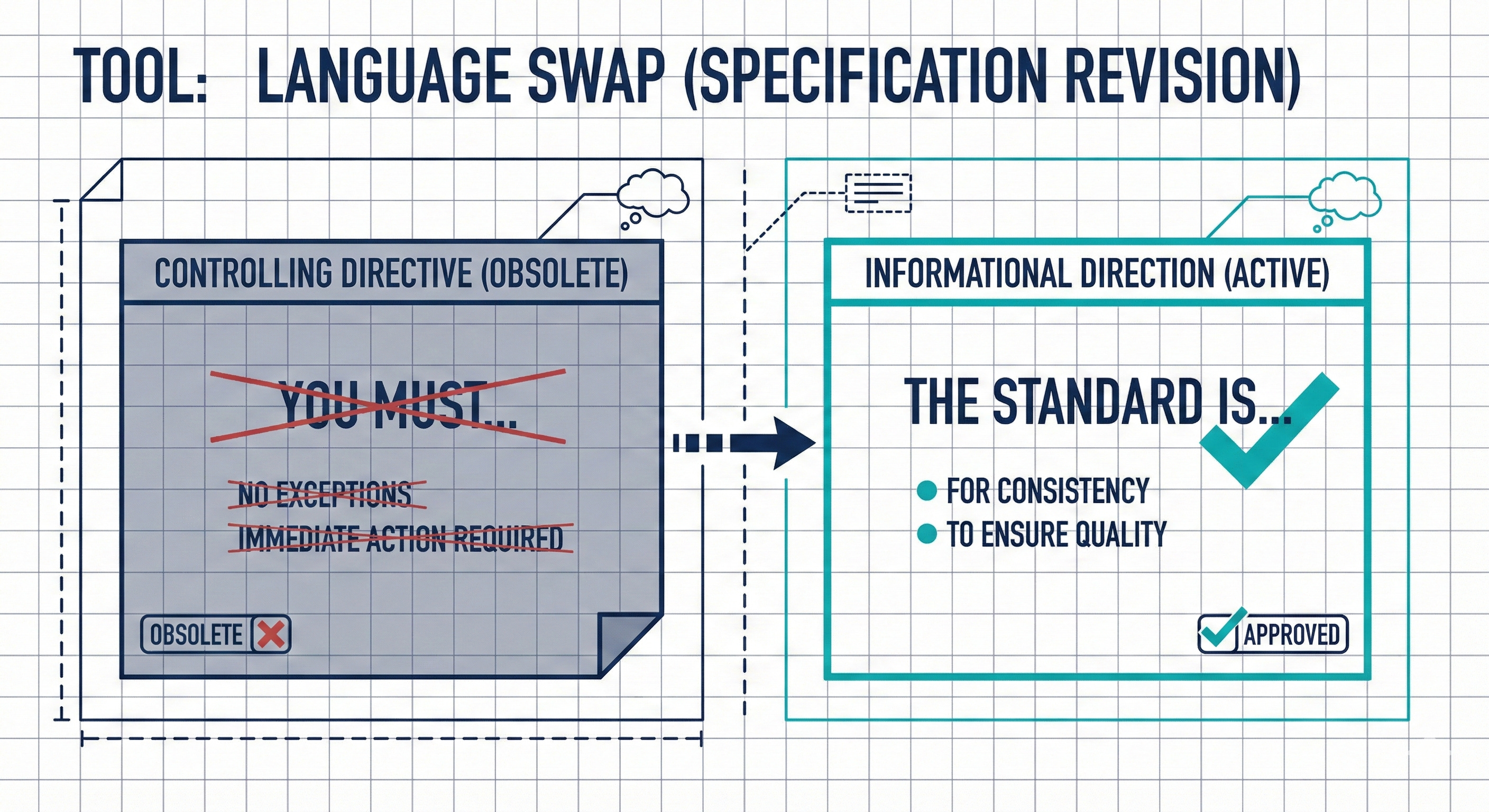
Replace controlling directives with informational, non-controlling language:
Replace 'You must' with 'The standard is...' (and here’s why it matters… )
Replace “We need you to” for “Here is what we are aiming for and why…”.
Replace 'No excuses' with 'Here are the constraints we are removing to make this doable.
The goal is to provide clear direction without triggering psychological reactance, which occurs when people feel their behavioral freedom is threatened.
Play: Refine Identity Anchoring
If Meaning stops at “I see the value,” you’ll get short-term adoption. The hardest part of a change initiative is sustaining it. This happens when the change becomes consistent with someones professional identity.. basically how someone wants to show up at work.
Ask:
What standards do you refuse to compromise on?
What does good look like in your role when things are working?
What would you be proud to be known for six months from now?
Linking the change to professional identity facilitates integrated regulation, the most autonomous form of motivation. This occurs when the change is no longer just a 'task' but is fully assimilated into how the person sees themselves and their professional values, leading to greater persistence and higher quality performance
What to track (leading indicators)
Don’t wait for lagging adoption metrics, instead track internalization signals.
· Voluntary uptake: adoption without incentives, surveillance, or escalation.
· Trade-off literacy: people can name costs accurately.
· Sense-making equilibrium: defensive justification questions go down; operational integration questions go up.
· Role-level rationale quality: people can state the “why” in their own words at the point of work.
· Perceived locus of causality: the lived narrative switches from “they are making us do this” toward “we are doing this to solve X.”
One thing to try next week
Run a 45-minute Meaning session with one team.
Agenda (copy/paste)
· 5 min: The change in one sentence.
· 10 min: Three-level rationale draft (company/team/role).
· 10 min: Name friction removed per role + name the trade-off.
· 10 min: Sense-making loop (“Pros / cons”) to surface risks early.
· 5 min: Non-negotiables vs negotiables.
· 5 min: Pick one bounded choice to test this month.
What to capture (so it doesn’t become another meeting)
· The role-level rationale line per role.
· The trade-off line (what gets worse short-term).
· The one system change you will make (time/tools/permissions/workflow).
· The one experiment you will run next week.
You’ll learn more from that than another month of comms.
The Power of Interdependence: While we focused on Meaning, research emphasizes that the three basic needs are interdependent. Meaning provides the 'why,' but for change to sustain, it must be supported by Mastery and Belonging.
When either is missing, organizations compensate with pressure, monitoring, or incentives, and the change becomes less sustainable.
Next up in the series we will explore Mastery.
I help your company leverage the science of behavior change. I offer behavioral science consulting, training and tools for transformation | culture change | leadership | products.
If you’re finding these insights valuable, share them with a colleague, and maybe subscribe to them if you haven’t done so already.
Very best, Robert
Blimey this really is indispensable to change and transformation programmes. Thanks for sharing x